
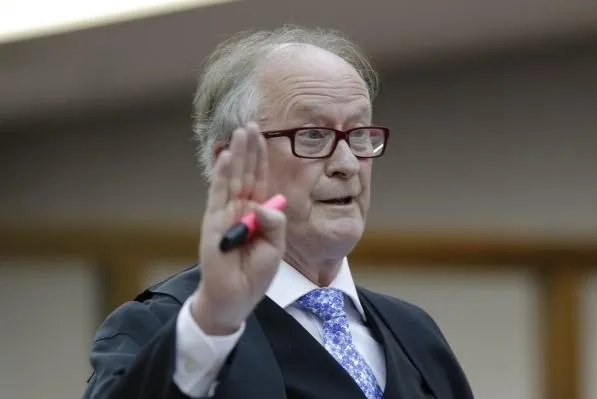
The defence team for accused killer Mark Lundy has shifted its argument today, away from accusing Christine Lundy’s brother, Glenn Weggery, of the crime, and instead suggesting that “in a way, we all killed the Lundy family.”
While over the several preceding days, Lundy’s team had explicitly argued it was Mr. Weggery who killed Christine and Amber Lundy, defence lawyer David Hislop, QC, now says he meant that “in more of a holistic way.”
“Whether it was Mark or Glenn who physically took up arms against the victims 14 years ago is, ultimately, a rather academic distinction,” Hislop told the court today. “When we say that it was clearly Mr. Weggery who was responsible for the murders, we do indeed mean it, in the same way we mean it when we say that Mr. Lundy committed the murders, or when we say that I committed the murders, or that all of you out there, in the jury, that you too, committed these murders.
“Did not we all commit these murders?
“Are not the collective sins of our society and human depravation ultimately responsible for the horrors that took place on August 29th, 2000, or September 11th, 2001, or during the holocaust, or during the enslavement of human beings in Europe, and Egypt, and the United States, and Pak N’ Save?
“And what about magnets? How do magnets work?”
According to those inside the courtroom, the jury was reportedly “captivated” by Hislop, who went on a lengthy two-hour rant about free will, and whether it was possible for a human being to truly commit a crime in the first place.
“There are some who say that we have no free will,” said Hislop, before staring thoughtfully at the jury. “They say that all things, all events, our decisions and preferences included, are the inevitable result of an infinite causal chain that stretches back long before we were even born.”
“If all events have causes,” he said, “then every event is the result of a cause, and every cause is the result of causes that came before it. So if we accept that every one of our decisions has a cause, and that every one of those causes has a cause, then it would seem fair to say that we are merely slaves to that which has come before, caught helplessly under the tyranny of past events.
“Even if we were to deny that every cause has a cause, then we would merely be affirming the existence of causeless or self-caused events, and we are no more responsible for uncaused events than for those events that were inevitable to begin with.
“But you likely think nothing of this, if you even believe it at all. Why should it matter anything to you, anyway? Everything is out of our control. So what? Big deal; it doesn’t change anything.
“But it does. It changes everything by making everything unchanged, everything unchangeable. ‘I spilt my coffee’ simply cannot be ‘I could not have spilt my coffee,’ because that simply wouldn’t be true, and if it were true, it would only be so because of the occurrence of a random, uncaused event outside of the inevitable cause-effect chain of this world, and thus my not spilling the coffee is not up to me, but rather the whimsy of a chaotic universe.”
Hislop then presented to the court Exhibit 16b: a caterpillar stuck inside a volumetric flask.
“What is a mirror?” he asked. “Is it a reflection of our world, or is it a window into a completely equal, synchronized, but opposite world?”
He paused, in silence, for several moments, before asking “Has anyone here ever broken a mirror?”
One member of the jury raised her hand.
“You destroyed an entire universe,” said Hislop, furiously. “You killed everyone. How dare you?”
Hislop’s closing comments for the day consisted of a question for the jury.
“So I ask you, ladies and gentlemen of the jury,” he said. “Was it really Mark Lundy who killed his family, or was it spiders?”