
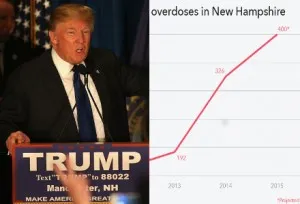
Donald Trump’s decisive victory in the New Hampshire Republican Primary yesterday served not only as a watershed moment in US political history, but also a chilling reminder of the state’s runaway heroin and opioid problem.
Trump’s victory came on the back of a loss in the first-in-the-nation caucus state of Iowa, where Senator Ted Cruz took a victory in large part due to the state’s heavy concentration of evangelical voters.
But the landscape proved to be less favourable to him in New Hampshire, where a staggering 11.4% of 18-25-year-olds are heroin users, a demographic that helped deliver the primary to Trump.
“Well I must say, you know, I do very well amongst heroin addicts,” Trump acknowledged this morning on MSNBC’s Morning Joe programme. “Heroin addicts love me. I think I’m going to be great for the heroin addicts.”
Election analyst and statistician Nate Silver said it was “no surprise” Trump performed so well in a state with such a rampant illicit drug problem.
“In some ways, this kind of demographic is his wheelhouse, really,” he said. “You know, we went to New Hampshire, spent about a week there, got a sense of what it was like on the ground. You wouldn’t go to a Trump rally without seeing at least a few people loading up at the door.
“And Trump’s just being Trump, he’s throwing needles to the crowd, everybody’s loving it. So while his margin was a little surprising, maybe better than expected, these people were always going to deliver for him.”
The high number of heroin and other drug users in New Hampshire may also help to explain the decline of New Jersey Governor Chris Christie, who, despite a strong debate performance in the lead-up to the primary, had spent the last week being “a real downer” about drug use.
In recent years, heroin addiction has also become a major problem in the states of Delaware and Vermont, where Trump is expected to perform just as well.
You can read more about the figures behind Trump’s New Hampshire victory here.